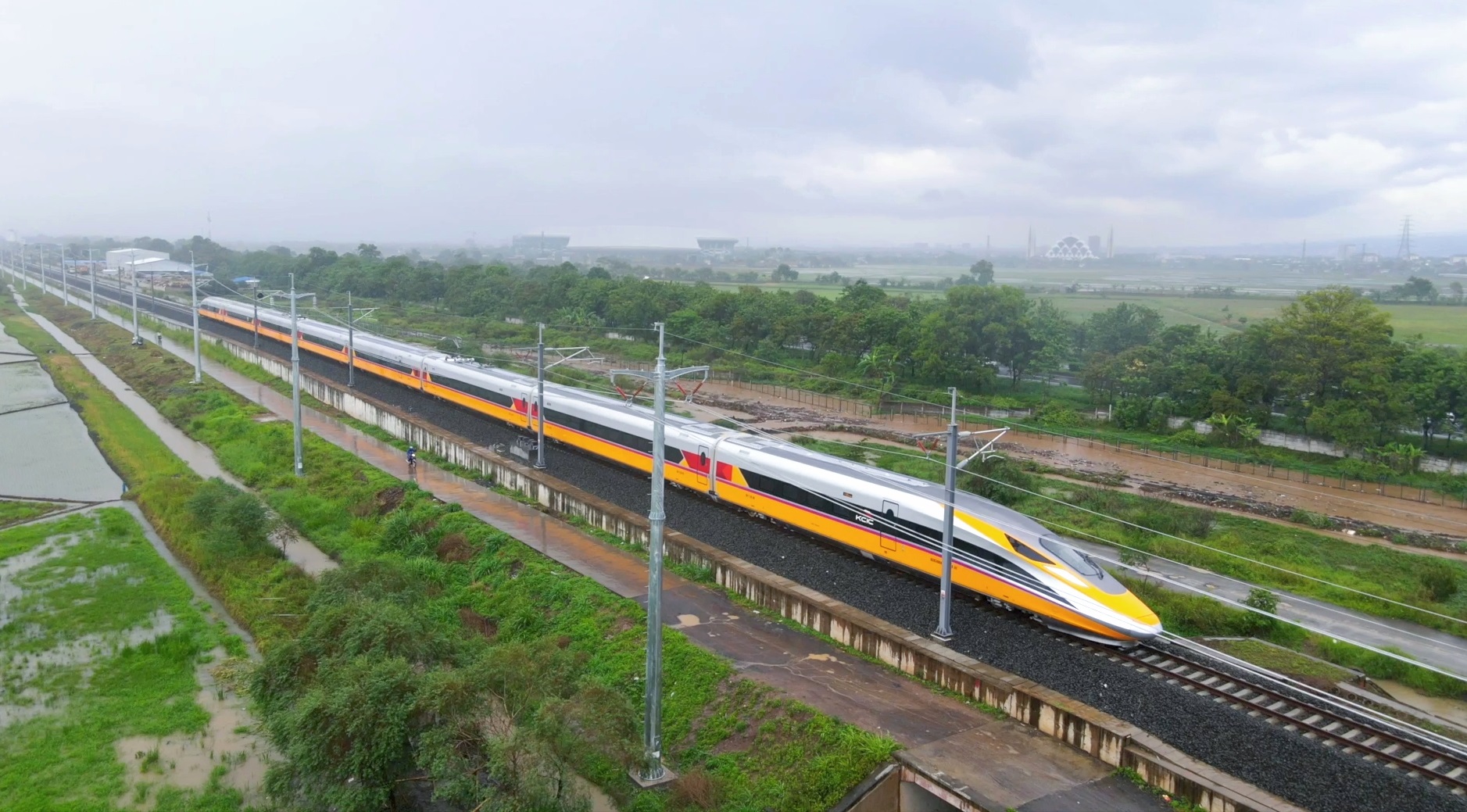
A comprehensive test on Jakarta-Bandung High Speed Railway in Indonesia was completed after a China-made comprehensive inspection train finished its run on the railway’s trial section from Tegalluar station to No.4 casting yard, on November 16. All data collected on the test run showed the railway performed well, marking a successful trial operation of the railway jointly built by China and Indonesia.
This high speed railway project marks the first time the high speed railway was exported abroad with systemic and whole-of-supply chain, and is considered a landmark project under the China-proposed Belt and Road Initiative (BRI), and the hallmark of Sino-Indonesian cooperation. The 142.3-kilometer line, with a maximum speed of 350 kilometers per hour, connects the Indonesian capital Jakarta with the tourist city of Bandung, and upon completion, it will reduce travel time between the cities from more than 3 hours to just 40 minutes. The high speed railway is the first overseas construction project that fully uses Chinese railway technologies and standards. The construction, starting in June 2018, was led by CHINA RAILWAY International Co., Ltd, a subsidiary of CHINA RAILWAY.
Currently, under the push by both Heads of State and through the joint efforts of the Chinese and Indonesian railway builders, the construction of the railway is proceeding smoothly. All 13 tunnels along the route have been connected and the erection of the box girders is already completed. The overall construction has now entered the track-laying stage. So far, the development of high speed EMUs and comprehensive inspection trains for the project has been finished; a testing section, the 14-kilometer section between Tegalluar Station and No.4 casting yard is completed; a hot running test of the OCS system under power-on condition has been completed.
The test run checked multiple systems including the earthworks, tracks, communication, signaling and traction power supply. The comprehensive inspection trains were built using Chinese standards while taking account of the actual operating conditions in Indonesia. The trains, with the maximum inspection speed of 385 kilometers per hour, are able to measure more than 60 key parameters in terms of track, OCS system, signaling and communication, and equipped with advanced functions such as precise detection, fault diagnosis, real-time alarm and data processing, which support the high speed railway's maintenance and operation security. The result of the trial operation showed all indicators and parameters had fully met the design criteria, thus providing a solid foundation for the project's future construction and operation.
Jakarta-Bandung High Speed Railway will greatly improve local traffic conditions and boost social and economic development along the route. The project also plays an important role in deepening pragmatic cooperation between China and Indonesia, as well as promoting the joint building of the BRI and high-quality development of Indonesia’s global maritime fulcrum (GMF) strategy.
 附件:
附件: